


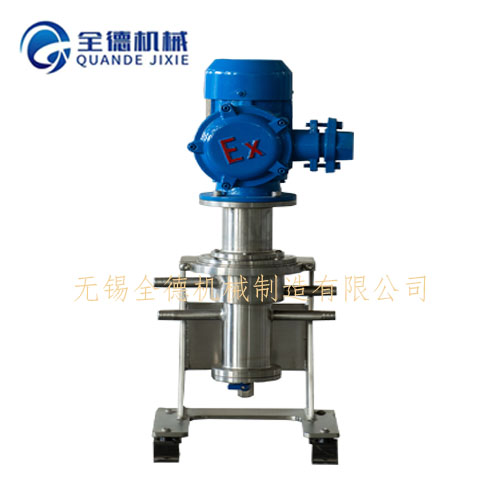
Low-flow CQL50-D experimental centrifugal extractor | |
|
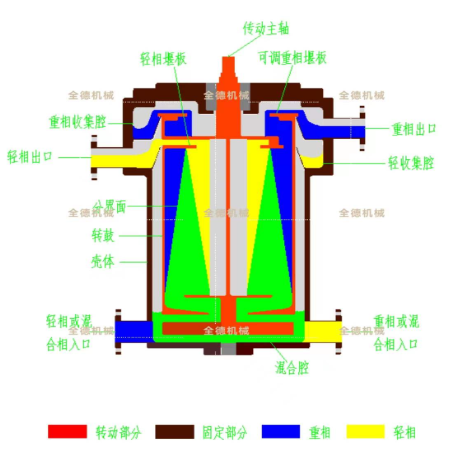
产品详情 Technical Parameters of Centrifugal Extractor Model CQL50-DCentrifugal Extractor Principle: The centrifugal extractor is a multi-functional equipment that utilizes centrifugal force to achieve liquid-liquid two-phase extraction, separation, mixed mass transfer, reaction, washing and other processes. Two immiscible liquid phases with density difference are subjected to liquid-liquid separation/extraction by centrifugal force. The two immiscible liquid phases enter the centrifugal extractor respectively, and are fully mixed by the rotating rotor and mixing impeller to promote solute transfer. After mixing, the mixture is drawn into the rotor for gradual separation/extraction. The separated liquid phases are collected in the two collection chambers (for light phase and heavy phase respectively) and then discharged through their respective outlets. By replacing weir plates and adjusting rotational speed, the equipment can adapt to materials with different densities and viscosities. Centrifugal Extraction/Liquid-Liquid Separation Working Principle (as shown in the diagram)
During liquid-liquid separation/extraction by the centrifugal extractor, a solution containing one or more solutes (shown in blue in the diagram) and an immiscible solution with density difference (shown in yellow in the diagram) enter the equipment's mixing chamber. The rotary drum and mixing impeller rotate to mix the materials (shown in green in the diagram). The mixture is drawn into the rotary drum for phase separation. Under the centrifugal force of the rotating rotary drum and the gravity of the materials, the heavy phase (blue) is distributed to the outer side of the rotary drum, and the heavy-phase liquid overflows from the adjustable heavy-phase weir plate into the heavy-phase collection chamber and is discharged. The light-phase liquid (yellow) overflows from the light-phase weir plate on the inner side of the rotary drum into the light-phase collection chamber and is discharged.
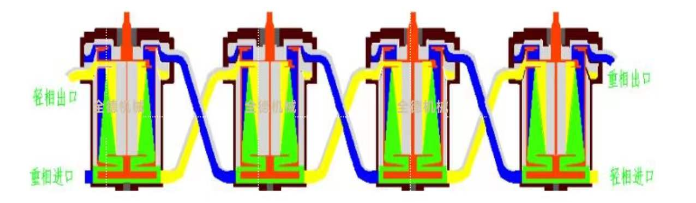
Multi-Stage Countercurrent Extraction (as shown in the diagram) Multi-stage countercurrent extraction enables the extraction process of various materials, ensuring indicators such as extraction purity and clarity. The process is simple, no pumps are required between extraction stages, and the number of stages can be flexibly increased to meet better production process requirements. According to process needs (e.g., reaction, washing, stripping), stages can be directly added to or removed from the process pipeline. Equipment Design Features (Advantages): 1. Driven by a vertical direct-coupled motor, with a compact structure, easy maintenance and small floor space. 2. High rotational speed for rapid phase separation, capable of separating materials with a density difference of ≥0.015. 3. Foundation-free installation; can be placed on relatively level ground, floors or platforms. 4. Facilitates single-stage or multi-stage series countercurrent or cross-flow washing, reaction and extraction separation. 5. Strong adaptability; can meet the requirements of liquid materials with different densities and viscosities by replacing weir plates and adjusting speed. 6. Small internal volume of the equipment, saving extractants, solvents or detergents. 7. Fully enclosed operation with no leakage, suitable for explosion-proof scenarios and materials that are toxic, harmful or volatile. 8. Simple and quick commissioning; when changing processes or materials, the weir plate can be quickly adjusted or the speed can be modified to change the centrifugal force and switch the phase separation interface. 9. No pumps are required between stages when used in multi-stage series; the number of extraction stages can be arbitrarily increased to achieve the optimal extraction effect. 10. Stable operation with high automation, enabling unattended continuous or batch operation. 11. Multiple mixing designs available, selected according to material properties to improve mass transfer efficiency; suitable for shear-sensitive emulsified materials. 12. GMP-compliant optional CIP (Clean-in-Place) system, suitable for intermittent use or preventing cross-contamination when changing materials. 13. Large length-to-diameter ratio and high rotational speed, ensuring thorough phase separation. 14. No mechanical seals, eliminating leakage and reducing maintenance costs. 15. Low energy consumption; selected according to different media and flow rates. Widely used in: food, pharmaceutical, agrochemical, metallurgy, industrial wastewater treatment, biopharmaceutical, bioengineering, plant extraction, fine chemical, petrochemical, environmental protection chemical and other industries. |
|
|
Wuxi Quande Machinery Manufacturing Co. , Ltd
Telephone:0510-88273206
Faxed:0510-84390679569
Xida Road, Meicun, Xinwu District, Wuxi City